

Instead of repeatedly trying to wash yellow or orange out of freshly bleached hair, build your 2026 bleach to toned blonde hair at home workflow around two separate jobs: lift to an even base, then choose a toner for the colour you can actually see. Zilion lists toning and aftercare products for NZ shoppers, but stop before toning if the hair has lifted unevenly or feels fragile.
- Bleach to toned blonde hair at home means lifting evenly first, then selecting a toner for the visible base colour.
- A toner changes tone; it does not make an orange section as light as a pale-yellow section.
- Check the bleach and toner labels separately: their mixing ratios, application conditions and processing instructions can differ.
- Zilion is best for NZ shoppers choosing listed toning and aftercare products, not for correcting severely damaged hair.
Why this matters
Bleach removes pigment; toner adjusts the colour left behind. Yellow and orange are different starting points, so applying one toner across both does not make them match. If the lengths are already light but the roots are darker, treat that as a lift problem before you treat it as a toning problem.
The order is lift, inspect, tone, then condition. The guide to mixing hair bleach and developer safely covers the mixing decision in more detail. This 2026 guide focuses on the full sequence and the points where you should stop rather than push ahead.
A home workflow is a poor fit for hair that stretches unusually, breaks during a strand test, has extensive previous colour, or needs major correction. A colourist can assess those problems in person; a toner cannot repair them.
Before you start
- Gather the complete set: bleach and its specified developer, the toner you intend to use and any developer its instructions require, gloves, a non-metallic bowl if the bleach instructions call for one, an applicator, clips, a timer and conditioner. Do not assume the developer for one product suits another.
- Check your starting hair: note natural colour, previously dyed sections, existing lightened areas and visible differences between roots and ends. Test a discreet strand using the product instructions before applying bleach across your head. Follow each product's allergy-test directions as well.
- Read both sets of directions before mixing anything: confirm the mixing ratio, application to dry or damp hair, processing limit and rinsing instructions on the products in your hands. The non-obvious gotcha is that a toner labelled for blonde hair still needs a suitable starting shade; it will not lighten a section bleach left orange.
Do not start a 2026 home lightening session if you cannot identify what was previously applied to your hair or if the test strand becomes weak or breaks. Also postpone the process if your scalp is irritated. Those checks come before choosing a blonde shade, not after the bleach is mixed.
Hair and product check
- Map the hair. Separate untouched roots, previously coloured lengths and already-lightened ends in your plan. Do not assume they will process at the same rate.
- Inspect the packaging. Confirm that the bleach and developer belong together under their instructions. Check the toner's directions independently, including whether it needs a developer at all.
- Test a strand. Apply and rinse a small test section as the bleach maker directs. Examine it when dry so you can see both the resulting colour and how the hair feels before deciding whether to proceed.
Expected result: you know which sections need lifting, which sections must be kept out of the bleach, and whether the hair tolerates the planned process. If the test strand breaks or feels unusually elastic, stop and seek professional advice rather than shortening the next processing time and hoping for the best.
Bleach mixing and sectioning
- Prepare your workspace. Put on gloves, protect nearby surfaces and keep the bleach instructions where you can read them while working. Arrange the clips and timer before mixing.
- Section the hair. Make sections small enough to coat thoroughly. Keep already-lightened pieces separate so you do not accidentally overlap bleach onto hair that does not need another lift.
- Mix as directed. Measure bleach and the specified developer using the ratio and method on that bleach's packaging. Mix only when you are ready to apply it; do not substitute a ratio from a different guide or product.
- Apply according to the product instructions and your strand-test plan. Work methodically through the sections that need lifting. If you cannot coat them evenly or cannot see what you are doing at the back, get help rather than leave a section processing while you sort out the next one.
Expected result: the intended sections are coated evenly, previously lightened hair is protected from unnecessary overlap, and the timer is running within the product's stated processing limit. That is a useful checkpoint; it is not proof that the hair has lifted far enough for your chosen toner.
Lift, inspect and rinse
Check the strand as directed during processing, and never exceed the product's stated limit to chase a lighter result. Hair condition matters as much as colour: if you feel significant burning or see breakage, rinse immediately and stop the session.
In good light, compare the sections rather than judging a single strand. A toner can adjust an even yellow base; it cannot turn a darker orange patch into the same light blonde. If some areas are not light enough, do not cover the difference with toner or immediately bleach the whole head again. Rinse as instructed, assess the hair when dry, and get professional advice before attempting a further lift on compromised or uneven sections.
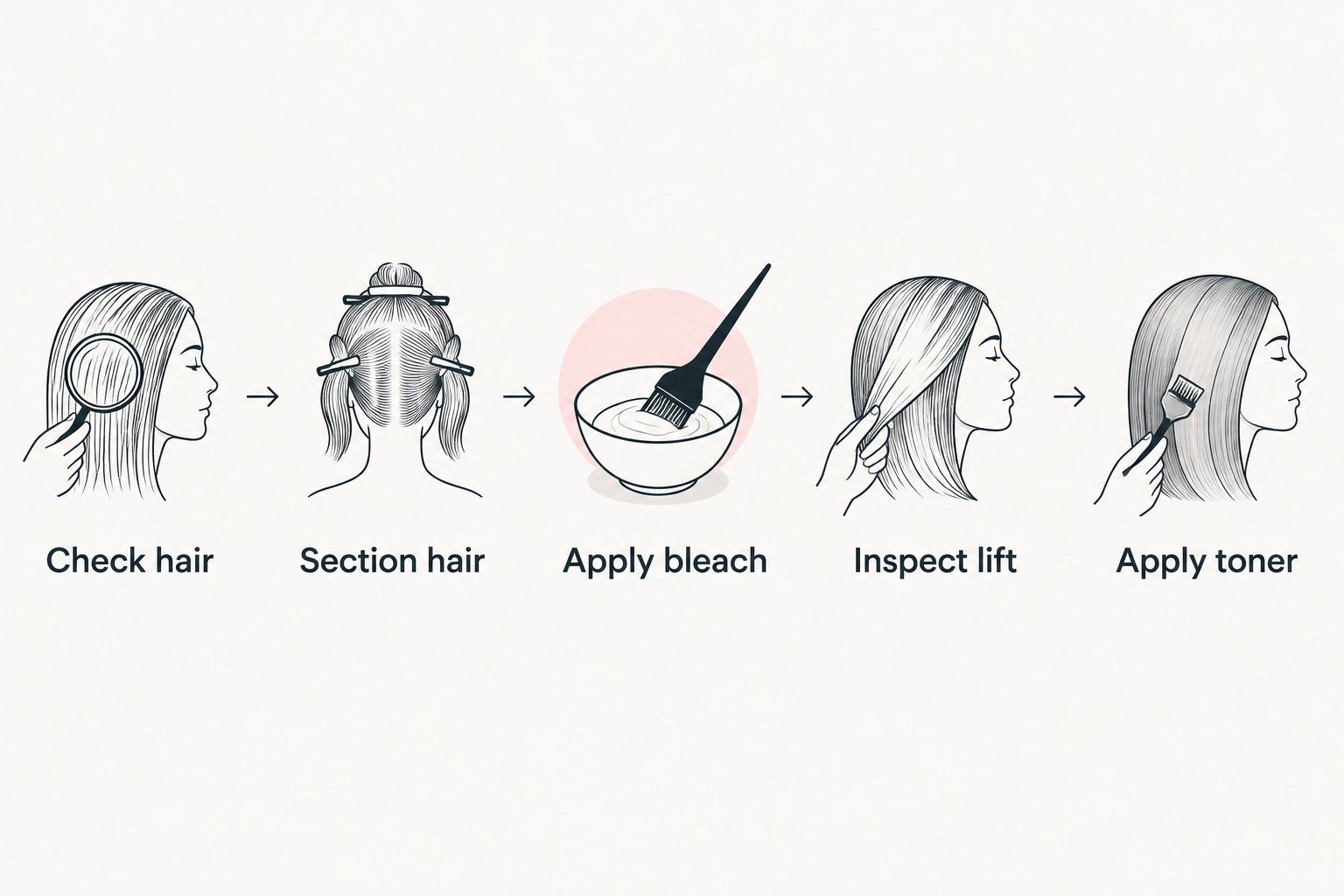
- Rinse thoroughly when the bleach directions tell you to stop, or sooner if the hair or scalp reacts badly.
- Follow the stated cleansing instructions. Do not add an extra product simply because another bleach guide recommends one.
- Inspect roots, mids and ends separately. Look for obvious differences in lightness and check whether the wet hair feels abnormally weak before moving on.
Expected result: bleach is fully rinsed out and the hair is sound enough for you to assess the actual base. If that checkpoint fails, the next step is not toner.
Toner and aftercare
Choose the toner for the colour you have after lifting, not the colour pictured on its packaging. Read its shade guidance and directions before mixing. For example, the listed Danger Jones Gloss Toner Developer 946 ml is a developer, not a toner shade; buying developer alone does not give you a finished blonde. Confirm the toner, developer and instructions are compatible before using them together.
- Check the toner's instructions. Confirm the required developer, mixing ratio, application conditions and processing limit. Some toning products deposit colour without developer; do not add it unless the product calls for it.
- Prepare the hair as specified. If the toner calls for damp hair, towel-dry first. If it calls for dry hair, dry it. Apply in orderly sections so every area you intend to tone receives coverage.
- Monitor the result within the stated processing window. Check a discreet section rather than waiting until the last moment to discover the tone is darker or cooler than you wanted.
- Rinse and condition as directed. Handle freshly lightened hair gently while washing, detangling and drying it.
Expected result: the tone is more consistent across sections that began at a similar lift level. A conditioner such as Nak Hair Signature Structure Complex Protein Conditioner 1000 ml belongs in aftercare, not in the bleach or toner mixture. Conditioner can improve the feel of hair, but it does not reverse chemical damage.
If you are comparing aftercare at Zilion, the products below are for the washing and conditioning stage. Neither is a substitute for a toner or a reason to continue bleaching hair that failed a strand test.


Refreshing an existing blonde without another lift
Already light blonde hair that has shifted warmer is a different job from dark hair that needs bleaching. If the lightness is still even and you only want to adjust the tone, assess a colour-depositing product before considering another lightening session. It adds colour rather than making the hair lighter.
| Option | Best for | Advantage | Limitation |
|---|---|---|---|
| Toner used according to its directions | An even, suitably light base that needs a specific tone | Lets you select a shade for the visible base | Cannot lighten dark patches; product-specific mixing and processing rules apply |
| Colour-depositing mask | An existing blonde that needs a tone refresh without more lift | Does not require a bleach step | Cannot lift roots or correct uneven lightness |
| Professional colour correction | Uneven lift, substantial previous colour or fragile hair | Allows an in-person assessment before more chemicals are applied | Requires an appointment rather than a home touch-up |
For this second 2026 workflow, inspect the washed and dried colour in natural light first. Choose a deposit-only product whose shade guidance fits that base, follow its application and rinsing instructions, then reassess after drying. If your complaint is that the hair is too dark, a depositing product is the wrong tool.
Troubleshooting
- Yellow lengths and orange patches: the starting lightness differs. Do not expect one toner to make both areas equally blonde; stop and assess whether further correction belongs with a colourist.
- Roots and ends look different: they may have different colour histories. Do not keep reapplying bleach to previously lightened ends just to make the timing convenient.
- Toner looks darker than expected: stop processing when the product directions require, rinse as directed and assess the dry result before applying anything else. Do not try to fix it with an immediate bleach application.
- Toner has little visible effect: check whether the selected shade suits the actual base and whether you followed its application and mixing directions. Developer on its own will not deposit the intended tone.
- Hair snaps, stretches unusually or the scalp burns: rinse the product out immediately. Pause further colour processing and seek advice from a qualified professional; another toner or conditioning step is not a fix for that warning sign.
Customise your workflow
Keep a record of the products used, the instructions on each package and what the dry test strand looked like. That makes a later root touch-up easier to plan without assuming the already-lightened lengths need the same treatment. In 2026, your next colour decision should still begin with the hair in front of you, not the result you got last time.
Separate maintenance from correction. Washing and conditioning products belong in the regular routine; a depositing product is for adjusting an existing tone; bleach is for lifting hair that genuinely needs to become lighter. Zilion is a practical place for NZ shoppers to compare listed products for those distinct stages, but an uneven or damaged result needs an assessment before another purchase becomes another application.
FAQ
How do I bleach to toned blonde hair at home?
Lift the sections that need lightening, rinse and inspect the result, then choose and apply a toner suited to the visible base. Follow the separate bleach and toner instructions, and stop if the hair becomes weak or the lift is uneven.
Can toner make orange hair pale blonde?
No. Toner can change the appearance of warmth, but it cannot make an orange section as light as a pale-yellow one. Uneven lightness needs assessment before toning.
Do I use the same developer for bleach and toner?
Only if both products' instructions explicitly permit it. Check the specified developer and mixing directions for each product separately; developer is not interchangeable by assumption.
Should I apply toner to wet or dry hair?
Apply toner to the hair condition stated on its packaging. Some instructions call for towel-dried hair and others differ, so do not substitute a general rule for the product you have.
Can I refresh blonde hair without bleaching it again?
Yes, if the hair is already light enough and only the tone needs changing. A suitable colour-depositing product adjusts the tone without lifting the hair further.
What if my hair feels stretchy after bleaching?
Stop further chemical processing and seek professional advice. Conditioner can be part of aftercare, but it does not establish that weakened hair is ready for another colour service.
Will purple shampoo fix patchy bleach?
No. Purple shampoo deposits tone; it cannot make darker patches as light as surrounding blonde hair. Inspect the dry result and resolve the uneven lift before treating it as a tone problem.
One last thing
The most useful 2026 blonde check happens before you open the toner: compare roots, mids and ends when you can see their colour clearly. If they are not at a similar lightness, more toner is not the next move. For an even base, Zilion shoppers can choose toning and aftercare products by their actual labels rather than buying a shade solely because its name sounds like the finished blonde they want.


